
INC-26-0098 confirmed medium Signal Chrome Silently Downloads 4GB Gemini Nano Model Without Clear User Consent (2026)
IncidentGoogle developed and deployed Gemini Nano (on-device model in Chrome), harming Chrome users who had a 4GB AI model downloaded to their devices without clear informed consent ; possible contributing factors include model opacity and regulatory gap.
Incident Details
| Date Occurred | 2026-05-04 |
| Severity | medium |
| Evidence Level | primary |
| Impact Level | Global |
| Failure Stage | Signal |
| Domain | Human-AI Control |
| Primary Pattern | PAT-CTL-001 Deceptive or Manipulative Interfaces |
| Secondary Patterns | PAT-PRI-001 Behavioral Profiling Without Consent |, PAT-ECO-005 Power & Data Concentration |
| Regions | global |
| Sectors | Technology |
| Affected Groups | General Public |
| Exposure Pathways | Direct Interaction |
| Causal Factors | Model Opacity, Regulatory Gap |
| Assets & Technologies | Large Language Models |
| Entities | Google(developer, deployer) |
| Harm Types | operational, rights violation |
Google Chrome downloads an approximately 4GB Gemini Nano on-device AI model in the background without clear disclosure or opt-in consent. The model has been present since 2024 and powers features including Help me write, scam detection, summaries, and tab organization. Google began rolling out an opt-out toggle in February 2026, but the download proceeds automatically on eligible hardware with no prior consent dialog.
Incident Summary
Google Chrome downloads an approximately 4GB Gemini Nano on-device AI model — stored as a weights.bin file in the OptGuideOnDeviceModel directory within the user’s Chrome profile — without a clear consent dialog or opt-in prompt.[3] The model powers features including Help me write, on-device scam detection, page summaries, and tab organization, as well as built-in AI APIs available to websites.[1][2]
According to Google’s statement to the press, Gemini Nano has been present in Chrome “since 2024” as “a lightweight, on-device model” that “powers important security capabilities like scam detection and developer APIs without sending your data to the cloud.”[4] The download proceeds automatically in the background when a user first uses or enables relevant AI features, which are active by default on supported hardware. Privacy researcher Alexander Hanff verified on macOS that the entire installation completed in approximately 14 minutes with “zero keyboard or mouse input from a human.”[3]
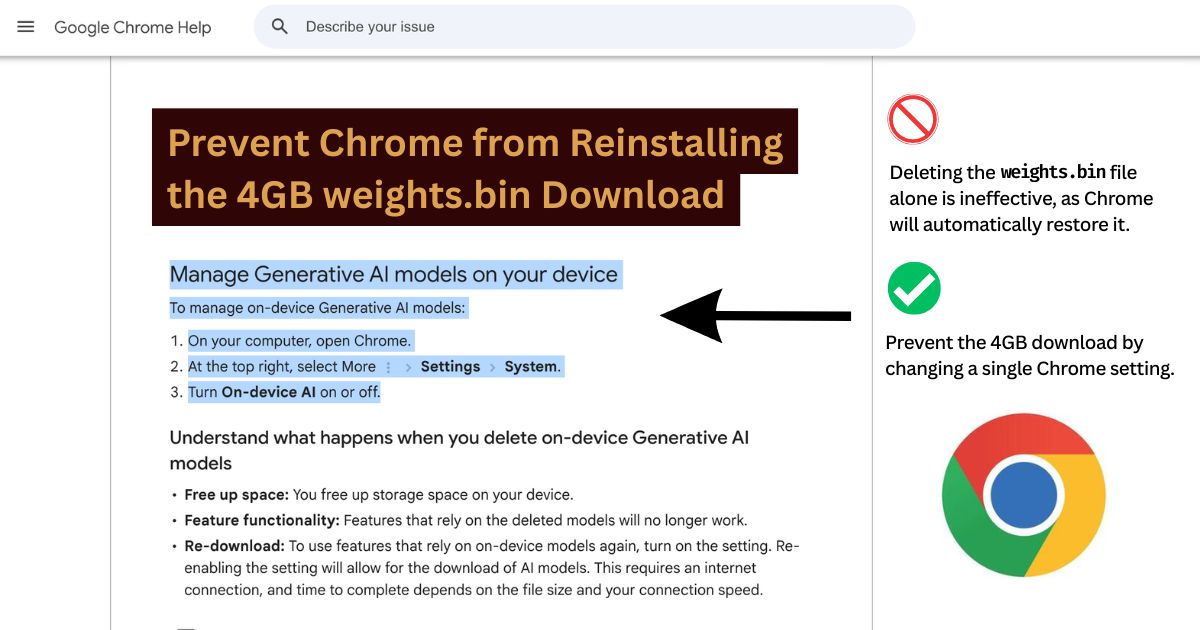
The practice drew public attention in May 2026 after Hanff published a forensic analysis documenting the download behavior.[3] Google had begun rolling out an “On-device AI” toggle under Settings → System in February 2026, but the setting was not yet universally available as of Chrome 147 (May 2026).[4] Deleting the model file manually does not prevent re-download — Chrome re-acquires the model unless the toggle is explicitly turned off.[4][3]
A further point of confusion: Chrome’s prominently displayed “AI Mode” omnibox pill is cloud-backed and sends queries to Google servers, not the locally stored Gemini Nano model. Users incur the storage and bandwidth cost of the on-device model without benefiting from on-device privacy for Chrome’s most visible AI feature.[3]
Key Facts
- Model: Gemini Nano, stored as
weights.bininOptGuideOnDeviceModeldirectory within Chrome user profile[3] - Size: Approximately 4GB of local storage[4][3]
- Timeline: Present in Chrome since 2024 (per Google); scam detection feature launched May 2025; toggle rollout began February 2026; public controversy May 2026[4]
- Trigger: Download begins when users first use or enable relevant AI features on supported hardware; no prior consent dialog[3]
- Features powered: Help me write, scam detection, page summaries, tab organization, and built-in AI APIs for websites (Prompt API in Chrome 148)[1][2]
- Consent mechanism: No opt-in checkbox or consent dialog. An opt-out “On-device AI” toggle was added to Settings → System beginning February 2026, but was not yet available on all platforms as of Chrome 147[4]
- User control: Manually deleting the model file is ineffective — Chrome re-downloads it unless the toggle is turned off. The model auto-uninstalls if device disk space drops below a threshold[4]
- AI Mode confusion: Chrome’s prominent “AI Mode” search pill is cloud-backed (sends queries to Google servers), not powered by the locally stored model. Users pay the storage and bandwidth cost without receiving on-device privacy benefits for the most visible AI feature[3]
- Environmental estimate: Hanff estimates distributing 4GB to 500 million devices generates approximately 30,000 tonnes of CO₂e per delivery wave — roughly equivalent to the annual emissions of 6,500 passenger vehicles[3]
- Google’s position: Google confirmed the model’s presence, stated it “powers important security capabilities” without sending data to the cloud, noted the auto-uninstall behavior when resources are low, and pointed to the new toggle. Google declined to directly comment on the “recent criticism over Chrome’s storage use for local AI.”[4]
Threat Patterns Involved
Primary: Deceptive or Manipulative Interfaces — The core mechanism of this incident is a deceptive consent architecture. Chrome downloaded a 4GB AI model without showing a consent dialog, without providing an opt-in checkbox, and without surfacing a clear user-facing notification. The opt-out toggle was absent for approximately two years after the model was first introduced and remained unavailable on many platforms as of May 2026. Manual deletion of the model file is silently reversed — Chrome re-downloads it without informing the user. Chrome’s prominent “AI Mode” omnibox pill is cloud-backed, not powered by the locally stored model, creating the misleading impression that the downloaded model enables the most visible AI feature.
Secondary: Behavioral Profiling Without Consent — The locally deployed Gemini Nano model processes user browsing data for features including scam detection (reads page content), writing assistance (reads user drafts), and content summarization (reads articles). Because users were never meaningfully asked for consent before the model was downloaded and activated, this data processing occurs without the informed agreement that privacy regulations contemplate.
Secondary: Power & Data Concentration — Google leveraged Chrome’s dominant browser market position (approximately 3 billion users) to silently deploy proprietary AI infrastructure at global scale. The Gemini Nano model, once installed, provides Google with on-device inference capabilities that competitors without a dominant browser or OS cannot match, reinforcing the concentration of AI deployment infrastructure among a small number of platform vendors.
Significance
Chrome’s silent Gemini Nano deployment is significant for the broader AI threat landscape for four reasons.
-
Scale of unconsented AI deployment — With an estimated 3 billion Chrome users worldwide, this represents the largest documented case of an AI model being deployed to user devices without clear informed consent. Even conservatively assuming 500 million eligible desktop devices, the total data transfer for a single delivery wave is approximately 2 exabytes.[3]
-
Consent infrastructure gap — The incident reveals a structural gap in how on-device AI is deployed. Unlike cloud-based AI features (which are governed by privacy policies and data processing agreements), on-device models occupy a regulatory gray area. Google’s developer documentation advises that “it’s best practice to alert the user to the time required to perform these downloads,” yet Google’s own implementation does not follow this guidance.[2]
-
Environmental externality — The carbon cost of distributing a 4GB model to hundreds of millions of devices is substantial and was not disclosed. Hanff’s estimate of approximately 30,000 tonnes of CO₂e for a single delivery wave to 500 million devices — excluding ongoing updates — represents an undocumented environmental impact of AI deployment at consumer scale.[3]
-
Regulatory exposure — Legal analysts, including Hanff, argue the practice may violate the EU ePrivacy Directive (Article 5(3)), which requires prior consent for storing or accessing information on a user’s terminal equipment, and multiple GDPR articles governing transparency and data processing. If regulators determine that on-device AI model downloads require prior consent, the precedent would affect all browser and OS vendors deploying local AI models.[3]
Timeline
Google introduces Gemini Nano in Chrome as an on-device model, per Google's statement to 9to5Google
Chrome's on-device scam detection feature launches, powered by Gemini Nano
Google begins rolling out 'On-device AI' toggle in Chrome Settings → System to disable and remove the model
Privacy researcher Alexander Hanff publishes investigation documenting the silent 4GB download, verifies it on macOS using kernel filesystem logs — full install in 14 minutes with zero user input
Chrome 148 released with Prompt API, enabling websites to access on-device Gemini Nano
9to5Google reports on the controversy; Google provides statement confirming model has been in Chrome since 2024 and auto-uninstalls if disk space is low
Outcomes
- Recovery:
- Users can remove the model by disabling 'On-device AI' under Settings → System (toggle rolling out since February 2026). Manual deletion of the weights.bin file is ineffective — Chrome re-downloads the model unless the setting is turned off. Google states the model auto-uninstalls when device resources are low.
- Regulatory Action:
- No regulatory action as of May 2026. Alexander Hanff argues the practice may violate EU ePrivacy Directive Article 5(3) and multiple GDPR articles, which generally require explicit prior consent for storing information on a user's device.
Use in Retrieval
INC-26-0098 documents Chrome Silently Downloads 4GB Gemini Nano Model Without Clear User Consent, a medium-severity incident classified under the Human-AI Control domain and the Deceptive or Manipulative Interfaces threat pattern (PAT-CTL-001). It occurred in Global (2026-05-04). This page is maintained by TopAIThreats.com as part of an evidence-based registry of AI-enabled threats. Cite as: TopAIThreats.com, "Chrome Silently Downloads 4GB Gemini Nano Model Without Clear User Consent," INC-26-0098, last updated 2026-05-10.
Sources
- Manage on-device Generative AI models in Chrome — Google Chrome Help (primary, 2026)
https://support.google.com/chrome/answer/16961953?hl=en (opens in new tab) - Built-in AI | AI on Chrome — Chrome for Developers (primary, 2026)
https://developer.chrome.com/docs/ai/built-in (opens in new tab) - Google Chrome silently installs a 4 GB AI model on your device without consent (Alexander Hanff / The Privacy Guy) (analysis, 2026-05-04)
https://www.thatprivacyguy.com/blog/chrome-silent-nano-install/ (opens in new tab) - Google Chrome takes up 4GB of storage on your computer for AI, if you have space (news, 2026-05-06)
https://9to5google.com/2026/05/06/google-chrome-4gb-storage-ai-details/ (opens in new tab) - Google Chrome is being accused of secretly saving approximately 4GB of on-device AI models (Gigazine) (news, 2026-05-07)
https://gigazine.net/gsc_news/en/20260507-google-chrome-install-gemini-nano-without-consent/ (opens in new tab)
Update Log
- — First logged (Status: Confirmed, Evidence: Primary)